A chocolate fountain next to a virtual welding machine, a lorry simulator and a homemade modern tractor simulator – this does not describe an innovation exhibition, but rather everyday life at the career guidance hub in Reshetylivka in Poltava region.
The message here is clear: vocational education is no longer a ‘backup option’ but is about high technology, decent wages and a conscious choice of career path.
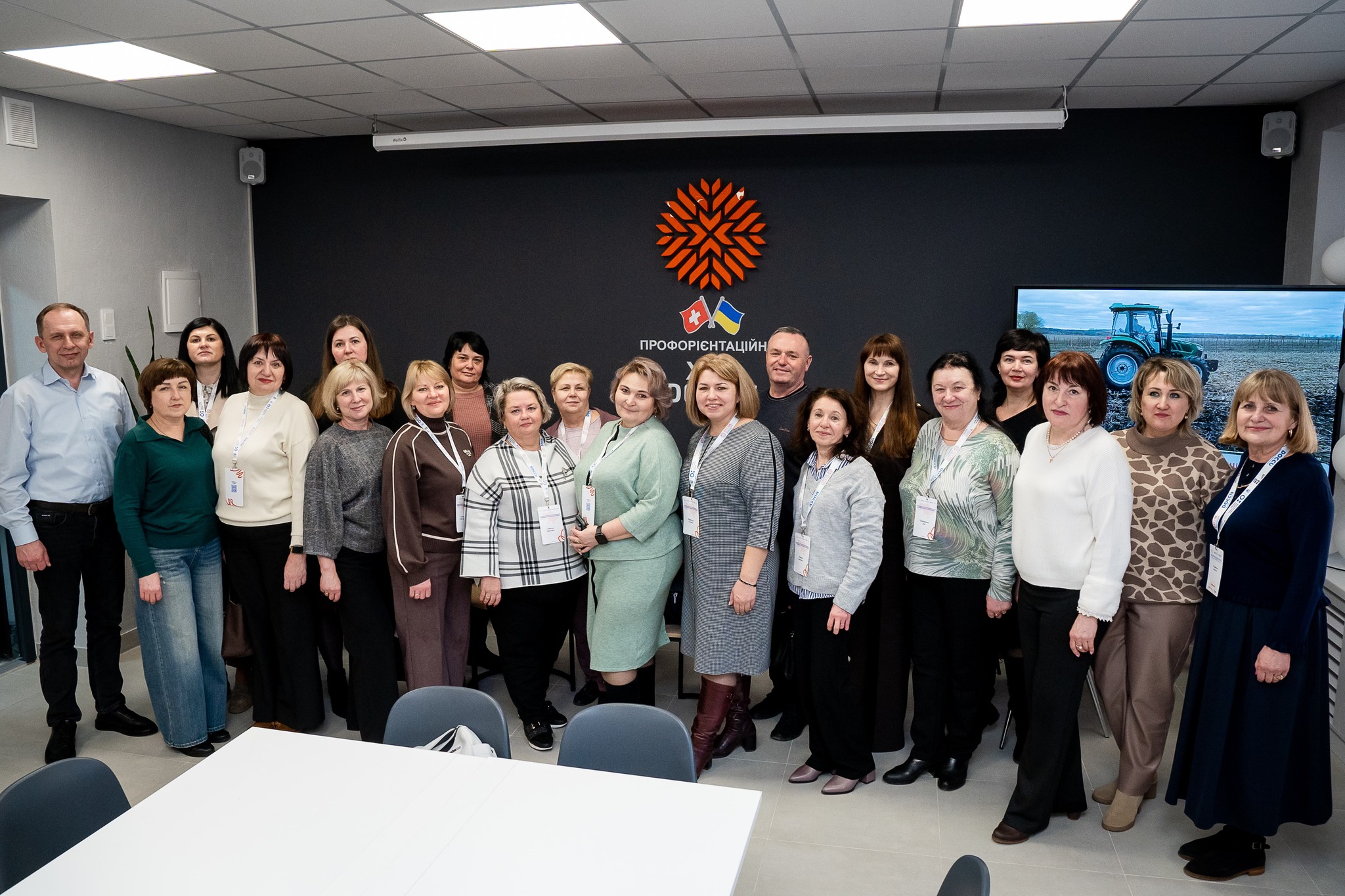
Today, there are already ten such hubs operating in six regions of Ukraine, established with the support of the Swiss-Ukrainian DECIDE Project in partnership with local authorities. One of them, the hub based at the I. H. Borovenskyi Reshetylivka Vocational Agricultural Lyceum has its own unique spirit and strategic importance for the entire community.
‘The Career Guidance Hub has been established with support from Switzerland. Its aim is to serve as a platform for cooperation between the education sector, business, and the authorities. Here, pupils in Grades 7–9 will have the opportunity to try out various professions offered at this school, talk to students already studying here, and attend masterclasses and training sessions led by representatives of the business sector. And then go on a field trip to a company or an internship to see what the work of a specialist in a particular profession looks like in real life,’ says Valentyna Poltorak, DECIDE Project Manager.
From 1986-era workshops to a ‘space-age’ environment
Until recently, the site of the modern hub was home to workshops dating back to 1986. Today, however, it comprises 210 square metres of high-tech facilities. The renovation took around a year and a half, and the total cost of the project was UAH 8.5 million, of which UAH 3.6 million were provided by DECIDE Project, and nearly UAH 4.9 million were co-financed by the Poltava Regional Military Administration and the Poltava Regional Council.
Nina Spilna, Director of the Vocational Education Institution, recalls how the idea arose to transform the outdated laboratories into an interactive space, ‘We always kept this room tidy; it had not been neglected. But we realised that the fittings were outdated and the equipment was obsolete. Now the doors to our hub never close: there are always children, visitors and even athletes coming for competitions – everyone rushes here to have a look. We wanted to create a space with a ‘wow’ factor – and we succeeded.’
The space has been designed with every detail taken into account by DECIDE team: from a separate entrance to ensure visitors do not disrupt the learning process, to full accessibility – lifts have been installed and specialised restrooms have been fitted out. There is also a modern bomb shelter nearby, which can be used to evacuate visitors in case of need.
The professions puzzle: a place to ‘touch’ the future
The hub is designed as a system of interactive zones, where each profession is represented by modern equipment. Here, children do not just listen; they get hands-on.
‘We recently asked adolescent students: “Are we doing everything right? Is this your vision for career guidance?” And we received a very sincere response: the children want to experience a profession first-hand. They said that a standard tour is interesting, but it does not provide a true understanding of the profession, as it remains purely visual. “We want to try it!” – that became our main guiding principle. That is precisely why our hub has become not just a place for observing, but a space where a child can actually “try on” a profession. Here, learning ceases to be mere observation and becomes a living experience,’ says Alla Kostohryz, Head of the Education Department at Reshetylivka City Council in Poltava region.
The hub features the following zones:
1. Culinary zone. This zone combines equipment for chefs, pastry chefs, and bakers.
‘As the new educational standards do not specify a strict list of teaching aids, we have tried to select the most relevant and modern equipment,’ explains Iryna Shevchenko, a vocational training instructor and chair of the chefs’ professional association. ‘We have installed a chocolate fountain, which always attracts the students. There is a 3D food printer that creates patterns and designs on wafer paper and cakes, and a coffee machine for mastering latte art. This demonstrates to teenagers that the profession of a pastry chef is, in particular, about creating masterpieces using intelligent systems.’
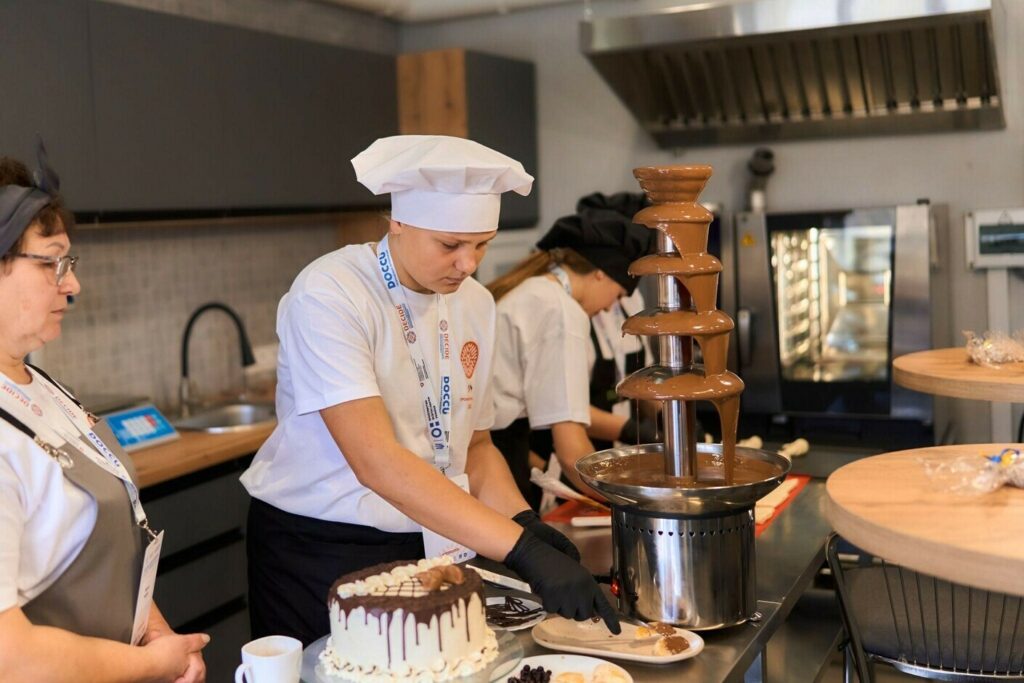
This zone also features a modern chocolate machine for preparing hot drinks; smart scales; a whisk; a modern microwave oven; a table with a refrigerated counter; and a modern combi-steamer.
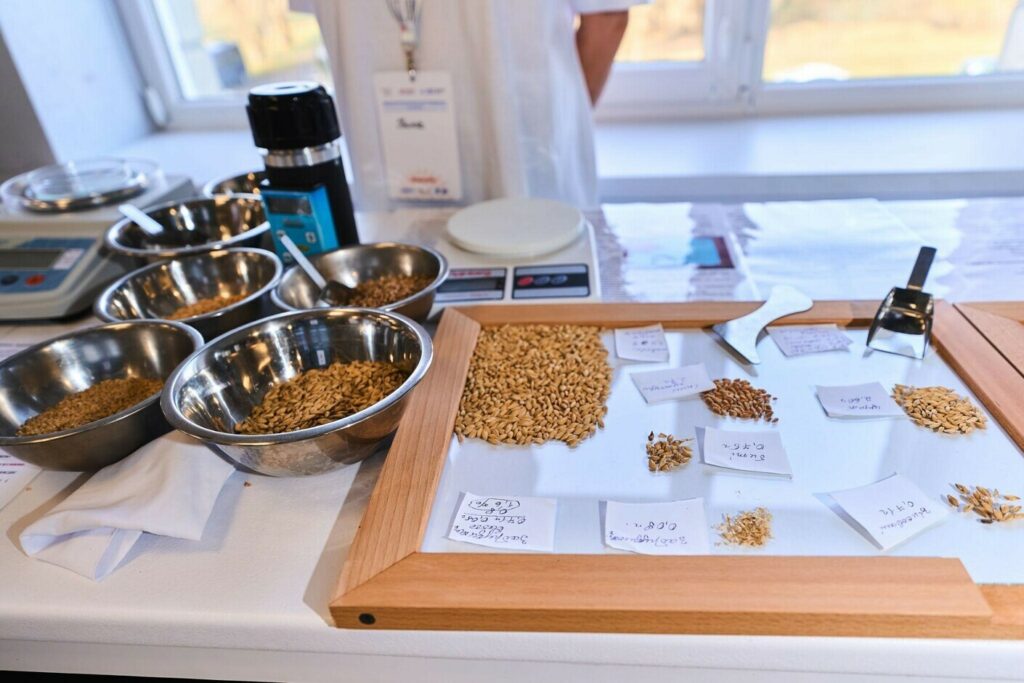
2. The chemical and bacteriological analysis laboratory functions as a quality control centre.
‘We have a state-of-the-art milk analyser that measures six parameters in a matter of seconds. What we used to do manually on a centrifuge is now done by a machine,’ explains Nadiia Samchenko, a lecturer in specialised technology for bakers and laboratory technicians. ‘We also have a digital microscope, a modern nitrate tester and even a makeshift grain reception laboratory – a sort of mini-elevator. The children see how science helps businesses to be efficient.’
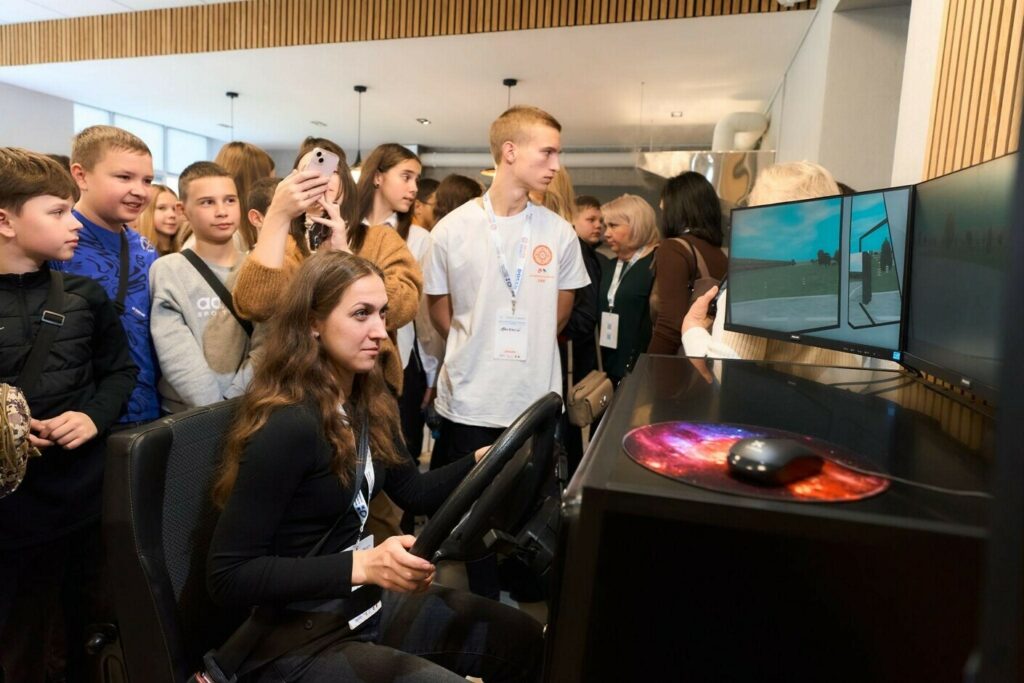
3. A zone for trainee drivers, equipped with a driving simulator based on a real KAMAZ truck.
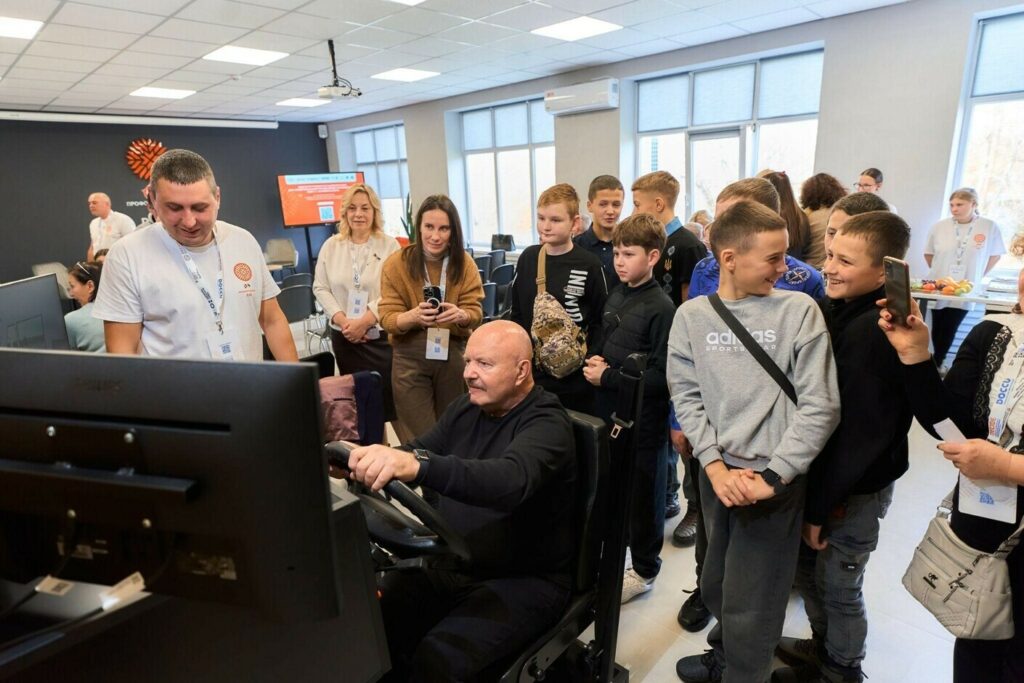
‘The controls, seats, steering wheel – everything is from a real truck. If something breaks, it can be replaced with parts from a real vehicle,’ explains Serhii Vovk, a specialist subject lecturer. ‘All the controls work just like on a real vehicle. In particular, it displays the engine temperature, fuel level, pressure, and battery charge. The programme can detect errors, award marks and provide verbal feedback. I can set any conditions for the student: rain, fog or night-time driving, and they must react instantly by switching on the windscreen wipers or lights.’
4. An Austrian Fronius VR simulator – one of the best in the world – has been purchased for future welders. When a student puts on the virtual headset, they are instantly transported to the workplace, where, under the instructor’s guidance, they can master the three pillars of modern welding: semi-automatic, arc, and argon arc welding.
‘The hub has transformed the children from passive observers into active participants: whereas on previous tours they would simply watch from a distance as the craftsman worked, they now sit down at the control panel themselves and make their first seam. This not only saves a huge amount of metal and electrodes in the early stages of training, but also provides incredible motivation – teenagers step away from the simulator feeling like winners and genuinely thrilled that “they did it”. They can feel the angle of the torch and the length of the arc. In fact, girls also study this specialism here, and some of them weld better than the boys,’ says Pavlo Motuzko, a vocational training instructor.
Besides, this solves a long-standing practical problem. In the past, right-handed teachers had to literally guide the student’s hand to convey the feel of the stitch. This posed a challenge when teaching left-handed students: the instructor could not demonstrate the movement with their left hand, so they had to call on senior left-handed students for help. Now, the simulator adapts to each student’s anatomy in a matter of seconds.
5. A ‘tractor’ innovation: when no ready-made solution was available, it was assembled in-house. The lyceum is particularly proud of its tractor simulator. It turned out that there were no ready-made, licensed simulators available in Ukraine, so the technicians and teachers came up with a creative solution.
‘We made a simulator for the tractor’s terminal and navigation tablet. The welders welded the frame on which the cab and seat stand. We purchased a real steering wheel, a joystick, and navigation tablets. This gives students the possibility to prepare for working with the machinery of large agricultural holdings. Our graduates this year are already keen to join such companies because they know how to work with modern systems,’ says Roman Tiutiunnyk, a specialist subject teacher.
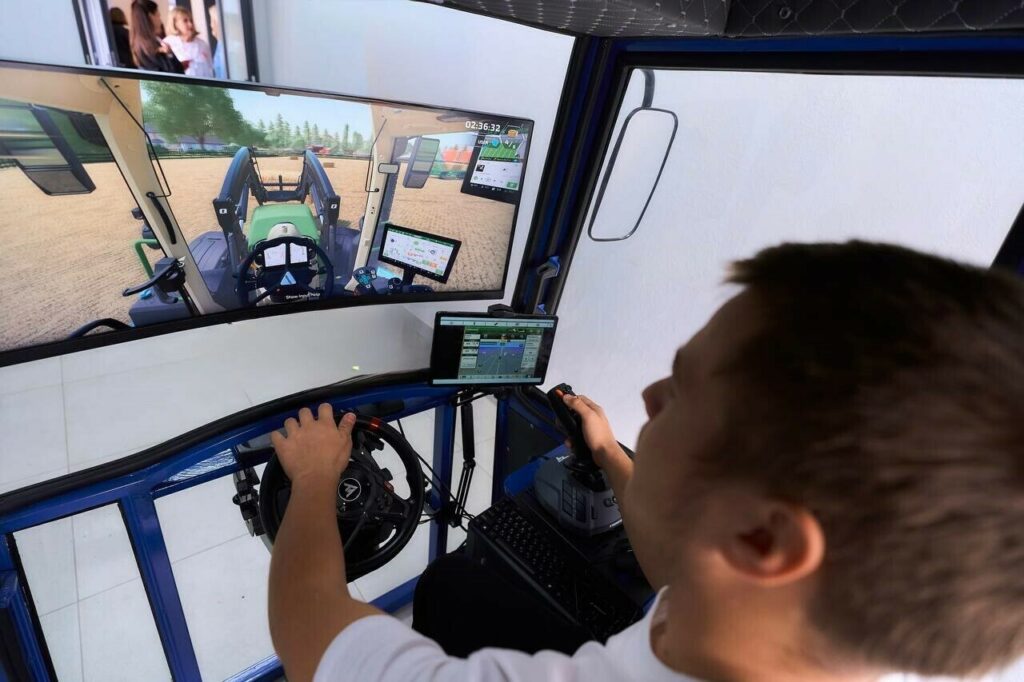
Nila Spilna, Director of the Vocational Education Institution, adds, ‘We did not just wait for ready-made solutions – we lived and breathed this project. The tractor drivers’ department was determined not to lag behind the welders or cooks. Our young and ambitious trainees were themselves inspired by the idea. It was a real driving force for the whole team. When a teacher is passionate about their work and creates something new from scratch, that spark is instantly passed on to the students. They see that here, lectures are not just delivered; the future is being shaped.’
All of this provides an opportunity to effectively guide students in their career choices, collaborate with employers, and retrain cooks in the community’s school cafeterias, thereby contributing to the reform of the school nutrition.
‘When schoolchildren come to the hub, they see the standard of the hub, the laboratories and the equipment, and ask their teachers with genuine enthusiasm, “When will we have something like this at our school?” This is precisely what breaks the stereotype of the “poor vocational school”. We have become the object of genuine envy, a place where children see opportunities that are not available in a regular classroom. Now students come to us not because “they have to go somewhere”, but because they want to learn in precisely these conditions,’ says Nila Spilna.
The Veteran Vector: Socialisation and adaptation through a new profession
A special mission of the hub is to assist veterans returning from the front line. In a community where over a third of the population has been affected by the war, the hub becomes a strategic platform for the entire community:
‘Returning after long-term service completely transforms a person’s outlook. Many had to learn how to drive or carry out repairs during the war out of necessity, and now want to pursue this professionally,’ emphasises Mykhailo Titik, Head of the Veterans’ Policy Department at the Reshetylivka City Council. The hub is a tool for socialisation and adaptation. Veterans, with their life experience, will become professionals who will strengthen the community.’
This retraining of veterans triggers an important chain reaction within families: a father or mother who has successfully mastered a modern profession becomes the best career advisor for their child. This transforms the hub’s work into a comprehensive social mission, where the example of adults’ successful careers directly shapes young people’s future choices, effectively changing the professional landscape of the entire community.
The lyceum has already won a tender from the Red Cross to provide free training for tractor drivers for combatants, their families, and people who have been forced to relocate due to the war.
Relieving the pressure on the lyceum and engaging parents
For Reshetylivska community, the hub has become a tool for resolving the education crisis. Under the New Ukrainian School (NUS) reform, the community will have only one academic lyceum, which physically cannot accommodate all ten-graders.
‘That is why we proposed that school principals do career guidance work to the fullest extent possible, in order to take the pressure off the academic lyceum,’ explains Alla Kostohryz, a representative of the local education department. In the past, schools did not want representatives from vocational education institutions to visit them, as they were afraid of losing pupils. Now the situation has completely changed: schools themselves are keen for children to go into vocational education. And the results are already visible: previously, 14–18% of school leavers in the community chose vocational education, but now this figure has risen to 30%.’
Valentyna Hladka, Head of the Hub, emphasises the role of parents in this process, ‘The child makes the decision, but we need to have the support of the family. When parents step into this modern space, they see that here, their child is learning a trade from experts using modern equipment. This breaks down stereotypes about vocational schools.’
Career guidance in Reshetylivka does not consist of boring lectures, but rather queues for the KAMAZ simulator and the excited exclamations of teenagers.
‘We constantly see the sparkle in the schoolchildren’s eyes, their enthusiasm. But perhaps there was an even greater sparkle in our own eyes when we realised that all this equipment, all these plans and efforts had finally become a reality. The best feedback for us is when a child simply does not want to leave the hub, when teenagers are queuing up to get behind the wheel of the simulator again or try virtual welding. The career guidance hub is not just about modern technology; its purpose is to help teenagers make the right choice at the most crucial moment. We see attitudes changing as we watch: at first, there is purely playful curiosity, but within an hour, serious questions emerge about admission requirements and real prospects in the job market. Our goal is that every visitor leaves with not just vivid impressions, but a clear plan and an understanding of their potential. This is a great responsibility to the community,’ concludes Valentyna Hladka.
The Career Guidance Hub is but one part of a comprehensive career guidance system. For example, in Reshetylivska community, over 100 pupils in Grades 8–9 took the JOBS course, developed by experts from the University of Zurich and adapted by DOCCU specialists within DECIDE Project, which was taught by career advisers. During the course, pupils completed exercises and tasks focused on self-determination and self-awareness, analysed their abilities, and learnt the basics of choosing a career. Moreover, over 630 children and teenagers visited enterprises in the community and the region.
Within the framework of the national pilot, over 14,000 children and teenagers have already joined the initiative. Even more intensive work is planned for this academic year. The hubs will expand, businesses will be involved in working with schoolchildren on a national scale, and career advisers will begin to be trained for all regions of Ukraine.